
KKR-backed logistics specialist is building up a head of steam.
Two years on from its initial launch Mirastar has begun motoring. Despite the lockdown the logistics investor, developer and asset manager has now amassed a portfolio and combined pipeline of almost €1bn. Fuelled by its capital partner KKR, it has recently added around £260m of assets or pipeline in the UK, as well as making its debut acquisition in Italy.
Currently operational in the UK, Benelux, Italy and Spain, it is due to expand into Germany and the Nordics before the end of the year and is targeting the creation of a €3bn to €4bn portfolio.
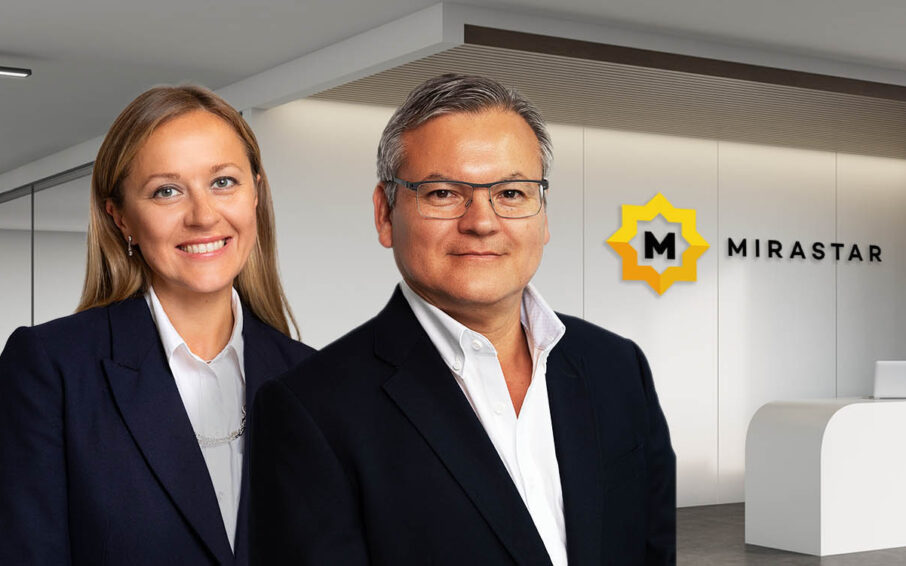
React News caught up with chief executive Ekaterina Avdonina and chief investment officer and Anthony Butler to talk new horizons, record high pricing and how Covid-19 has revolutionised the logistics sector.
How has the European logistics market evolved since you launched and how have you evolved with it?
Ekaterina Avdonina: Well, for one year of the two we have sat at home but we have achieved a lot. I think what has changed in the past year is obviously the working dynamics. I don’t think the particularly competitive landscape has changed because a lot of people already had real barriers to entry in terms of originating, networking and trying to figure out their strategy, so there’s been a lot of indirect investments in the sector into established platforms as a result. In the past year we have kind of actually had decreased competition because a lot of players couldn’t really access the stock or access opportunities through being in the lockdown whilst we have had people on the ground.
More competition will come of course, both from a combination of new outfits and also the existing outfits that will have more conviction in this sector. Our prediction is that yields are going to continue going only one way, but I think in the past two years we haven’t really seen too much of a change in the landscape. Logistics was previously sharing the crown with alternative asset classes as the most popular but now it is clearly out in front.
Has hitting value-add returns become more difficult?
EK: It’s always been hard to generate good risk-adjusted returns. Generating value-add returns on paper is not that difficult. You underwrite it, 25bps, yield compression, a little bit of rental growth and pretty much every deal will stack up. But it’s about understanding each market and submarket and the prospect of another market correction and the particular dynamics around what occupiers are doing.
That’s the real challenge in what we do.
Anthony Butler: It does get harder as the market gets hotter. You can’t rely on the market bailing you out. You have to be a little bit more focused and clever. You’ve got to choose your battles wisely. You’ve got to have an end buyer. As long as that healthy core market investor is still around trying to hoover up assets then I think you’ll continue to be able to realise those returns because people need to invest into income generating assets to provide distribution yields. Core capital has become far more sophisticated and educated about the logistics market.
You recently made your debut Italian acquisition. Why do you think there has been such an uptick in the country’s logistics market in recent times?
AB: There’s probably a few simple reasons. If you look at prime yields in Italy versus some of the other key markets, it’s still pretty healthy. If you look at the Netherlands, Germany, France where you’re into the low 3% range and then you’ve got Spain and Italy in the late 4% range.
You’re thinking, there’s too big a gap and so people are probably predicting yield shift in Italy, plus I think with e-commerce adoption I think people are just taking a view that it can only go one direction. Southern Europe was always a little bit behind some of the Western and Northern countries but the pandemic has meant that there has been a higher trajectory for penetration than anticipated. It’s one of the last obvious markets for people to go into and it’s simply because there’s a lot of capital out there.
EK: Exactly the same has happened in Spain. Because of the different work/life balance and because of the beautiful high streets of Southern Europe, in the minds of a lot of researchers they were always going to lag and stay behind Northern Europe in terms of e-commerce penetration but lockdown has scrapped all that.
To continue reading this article please visit https://greenstreetnews.com/article/qa-mirastar-on-its-e4bn-ambitions-italian-debut-heady-pricing/
This article originally appeared in Green Street News on 8th April 2021 and was written by David Hatcher.